
Consumers today increasingly expect foods and beverages made with recognizable, plant-based ingredients. This growing preference for clean-label products has accelerated innovation in natural blue food colors, one of the most technically challenging color categories in the food industry.
Unlike reds, yellows, and oranges, stable blue pigments are relatively rare in nature. As a result, food scientists and product developers must carefully evaluate color source, pH, processing conditions, storage requirements, and regulatory considerations when selecting a natural blue color system.
Fortunately, today’s formulators have more options than ever before. Botanical sources such as spirulina, gardenia blue, butterfly pea flower, Huito, blueberry, and red cabbage each offer unique performance characteristics that make them suitable for specific food and beverage applications.
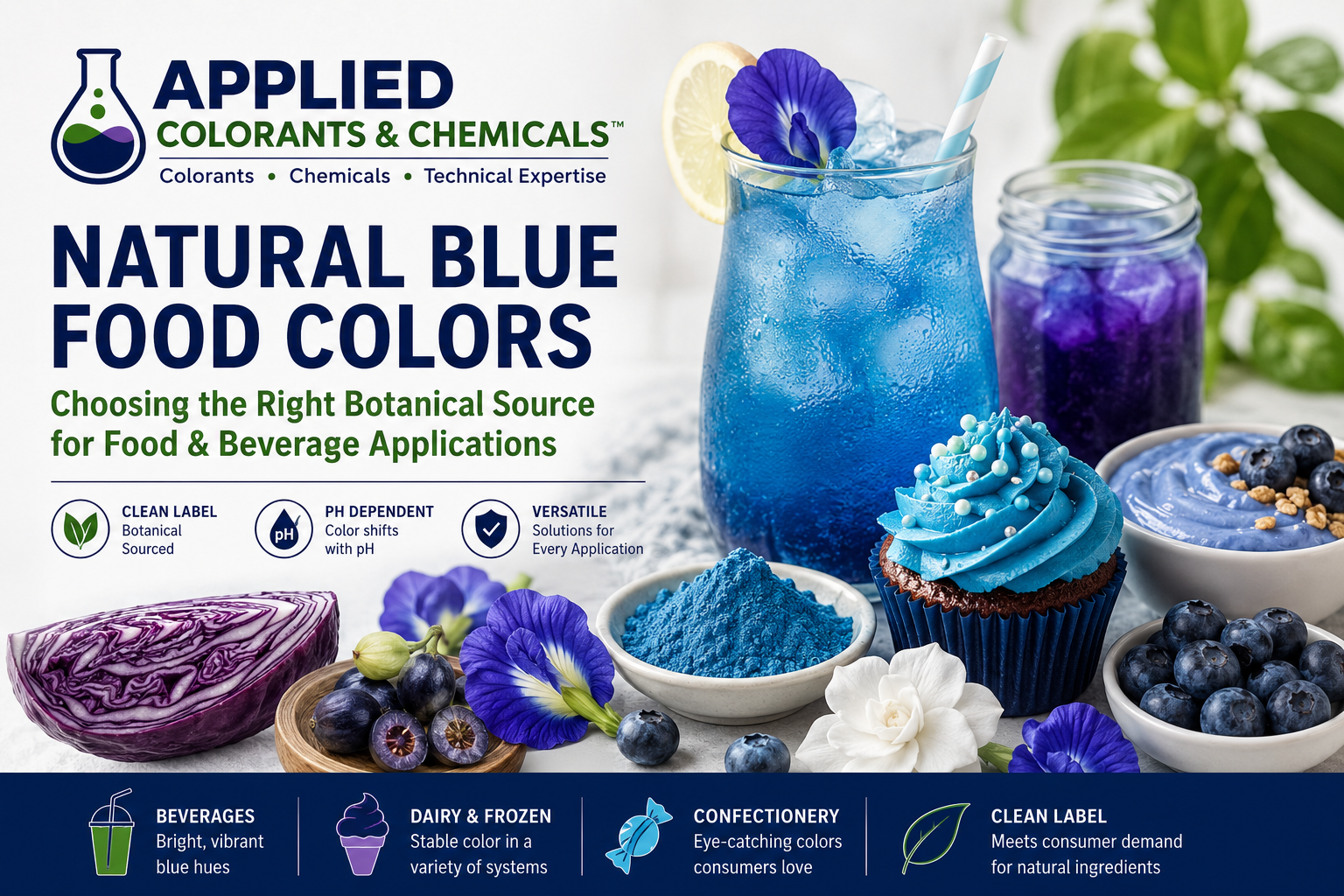
The key is understanding that there is no universal “best” natural blue color. The most successful formulations begin by matching the chemistry of the color to the chemistry of the finished product.
Whether developing beverages, dairy products, confections, baked goods, nutritional supplements, or specialty foods, selecting the appropriate natural blue food color can improve product appearance, shelf stability, processing performance, and consumer acceptance.
Quick Selection Guide to Natural Blue Food Colors
| Natural Color Source | Typical Blue Shade | Best pH Range | Heat Stability | Typical Applications |
|---|---|---|---|---|
| Spirulina Extract | Bright Sky Blue | Near neutral | Moderate | Dairy, smoothies, gummies, icings |
| Gardenia Blue | Rich Blue | Broad range | Good | Beverages, processed foods, confectionery |
| Butterfly Pea Flower | Blue to Violet | Neutral to mildly acidic | Moderate | Teas, beverages, cocktails |
| Red Cabbage Extract | Blue-Violet | Highly pH dependent | Good | Specialty beverages, novelty products |
| Blueberry | Violet-Blue | Acidic | Good | Fruit preparations, beverages |
| Huito (Genipa americana) | Deep Blue | Formulation dependent | Excellent in selected systems | Specialty foods and beverages |
Although each botanical source can produce attractive shades of blue, performance varies significantly depending upon formulation conditions.
Why Natural Blue Food Colors Are in High Demand
Natural food colors have experienced remarkable growth over the past decade. Consumer preference for recognizable ingredients, increased demand for clean-label formulations, and continued innovation in botanical extraction technologies have encouraged manufacturers to replace synthetic colors in many product categories.
Blue has remained one of the most difficult colors to replace.
Unlike synthetic colorants that provide consistent shades across a wide variety of formulations, natural blue pigments often respond to changes in acidity, heat, light exposure, oxygen, mineral content, and interactions with other ingredients.
This makes formulation expertise particularly important.
Food manufacturers developing a new beverage, confection, yogurt, nutritional powder, or frozen dessert must consider much more than simply selecting a blue ingredient. The entire food system influences final color performance.
As a result, successful product development often involves evaluating multiple botanical color technologies before selecting the optimal solution.
Why One Natural Blue Food Color Does Not Fit Every Application
One of the most common misconceptions is that all natural blue colors behave similarly.
In reality, every botanical source possesses a unique chemical composition that determines how it responds during manufacturing and throughout the product’s shelf life.
Some natural blue pigments tolerate pasteurization well but lose intensity in highly acidic beverages. Others perform beautifully in refrigerated dairy products but gradually fade under extended light exposure. Certain botanical extracts change from blue to violet simply because the product’s pH shifts by a single unit.
Even packaging can influence color stability. Oxygen permeability, UV exposure, and storage temperature may all affect long-term appearance.
For this reason, selecting a natural blue food color should always begin with the application rather than the pigment itself.
Questions that formulators often ask include:
- What is the finished product pH?
- Will the product be pasteurized or sterilized?
- Is it refrigerated, frozen, or shelf stable?
- What shelf life is required?
- Will the package be transparent?
- Is the desired color bright blue, navy, teal, or violet?
- Will the product contain fruit acids, minerals, proteins, or fats?
Answering these questions early in development helps narrow the list of suitable natural blue color systems.
Types of Natural Blue Food Colors
Several botanical sources have emerged as leading options for creating blue shades in modern food and beverage products. Each offers distinct advantages depending upon the application.
Spirulina Extract
Spirulina has become one of the most recognizable natural blue ingredients available to food manufacturers.
Derived from blue-green algae, spirulina contains the pigment protein phycocyanin, which produces an exceptionally bright, vibrant sky-blue color that is difficult to achieve using most other natural sources.
Because of its brilliant appearance, spirulina has become widely used in premium clean-label products.
Typical applications include:
- Nutritional beverages
- Smoothies
- Dairy drinks
- Yogurt
- Ice cream
- Frozen desserts
- Gummies
- Soft confections
- Frostings
- Nutritional supplements
One of spirulina’s greatest strengths is its ability to produce a vivid primary blue without requiring synthetic colorants.
However, phycocyanin is also relatively delicate.
Extended exposure to high temperatures, acidic conditions, ultraviolet light, and oxygen can gradually reduce color intensity. Consequently, spirulina often performs best in refrigerated products or applications processed under relatively mild manufacturing conditions.
Today, suppliers offer spirulina in several commercial forms, including standardized liquid concentrates, water-soluble powders, and customized formulations designed to improve processing convenience and color consistency.
Gardenia Blue
Gardenia blue has emerged as an increasingly important option for manufacturers seeking stable natural blue color systems.
Produced through carefully controlled processing of compounds derived from the gardenia fruit, gardenia blue can deliver deeper, richer shades than many botanical alternatives while maintaining good stability across numerous food applications.
Manufacturers frequently evaluate gardenia blue for:
- Ready-to-drink beverages
- Hard candies
- Gummies
- Bakery icings
- Dairy products
- Frozen desserts
- Nutritional beverages
- Powdered drink mixes
Compared with some protein-based pigments, gardenia blue may offer improved tolerance to certain processing conditions, making it attractive for products requiring greater manufacturing flexibility.
Commercial availability continues to expand as suppliers develop new formulations with enhanced shade consistency, stability, and regulatory compliance.
Gardenia blue is available in liquid concentrates, powders, customized blends, and application-specific formats depending upon the supplier and regional regulatory requirements. Availability and regulatory approval of gardenia-derived blue color systems vary by country and intended food application.
Butterfly Pea Flower Extract
Among the newest and most visually engaging natural blue food colors, butterfly pea flower extract (Clitoria ternatea) has gained worldwide attention for its brilliant botanical origin and remarkable pH-responsive properties.
Unlike spirulina, which generally maintains a consistent blue shade within its preferred pH range, butterfly pea flower naturally changes color as acidity changes. This unique characteristic allows product developers to create beverages and specialty foods that transition from blue to purple or violet when citrus juice or other acidic ingredients are introduced.
This dramatic color shift has made butterfly pea flower particularly popular in premium beverages, craft cocktails, wellness drinks, sparkling waters, botanical teas, kombuchas, frozen beverages, and innovative food products designed to create a memorable consumer experience.
Typical applications include:
- Ready-to-drink beverages
- Botanical teas
- Functional beverages
- Mocktails and cocktails
- Frozen beverages
- Gummies
- Hard candies
- Dessert toppings
- Specialty confectionery
Butterfly pea flower derives its color primarily from anthocyanins, a family of naturally occurring plant pigments found in many fruits and flowers. Like other anthocyanins, these pigments respond to changes in acidity, making formulation and pH control essential for achieving consistent color.
Commercial suppliers offer butterfly pea flower in several forms, including concentrated liquid extracts, powders, spray-dried ingredients, and customized formulations for specific food applications.
For manufacturers seeking an interactive, clean-label ingredient with strong marketing appeal, butterfly pea flower continues to be one of the most exciting natural blue color technologies available.
Red Cabbage Extract
Although many consumers associate red cabbage with purple vegetables rather than blue food colors, it has become an important natural coloring option because of its highly versatile anthocyanin profile.
Under carefully controlled formulation conditions, red cabbage extract can produce attractive blue and blue-violet shades while maintaining clean-label appeal.
Its greatest advantage, and its greatest challenge, is its sensitivity to pH.
As acidity changes, the color changes as well.
| Product pH | Typical Color Appearance |
|---|---|
| Below 3.0 | Red or Pink |
| 4.0 – 6.0 | Violet |
| 7.0 – 8.0 | Blue |
| 9.0 – 11.0 | Blue-Green to Green |
Because many beverages are naturally acidic, formulators must carefully evaluate whether red cabbage extract will produce the desired final shade.
Typical applications include:
- Specialty beverages
- Novelty beverages
- Functional drinks
- Candies
- Decorative confectionery
- Selected dairy products
- Premium desserts
Modern extraction and purification technologies continue improving color quality while minimizing flavor contribution and enhancing stability.
Blueberry and Other Anthocyanin Sources
Blueberries naturally appear deep blue on the outside, leading many consumers to assume they create bright blue food colors.
In reality, blueberry pigments generally produce violet or purple shades in most food systems because the anthocyanins respond to the acidic environment found in many foods and beverages.
Rather than replacing spirulina or gardenia blue, blueberry colors often complement them by producing softer berry tones or violet hues that consumers associate with fruit-based products.
Typical applications include:
- Fruit beverages
- Smoothies
- Yogurt
- Fruit preparations
- Frozen desserts
- Nutritional products
- Fruit snacks
- Bakery fillings
Blueberry extracts can be particularly attractive when manufacturers wish to emphasize fruit-derived ingredients while achieving naturally occurring berry shades instead of a bright primary blue.
Huito (Genipa americana) – Jagua Blue
Huito, sometimes referred to as Jagua Blue, represents another emerging option in the growing portfolio of natural blue food colors.
Derived from the tropical fruit Genipa americana, Huito develops its characteristic blue color through naturally occurring reactions involving compounds known as genipins.
Unlike many anthocyanin-based colors, Huito may provide excellent stability in selected formulations, making it attractive for specialty food applications where long-term color retention is important.
Manufacturers continue exploring Huito for use in:
- Functional beverages
- Confectionery
- Nutritional products
- Specialty dairy
- Innovative clean-label foods
Although commercial availability is still more limited than spirulina or butterfly pea flower, interest continues to grow as suppliers expand their portfolios of natural blue ingredients.
How pH Affects Natural Blue Food Colors
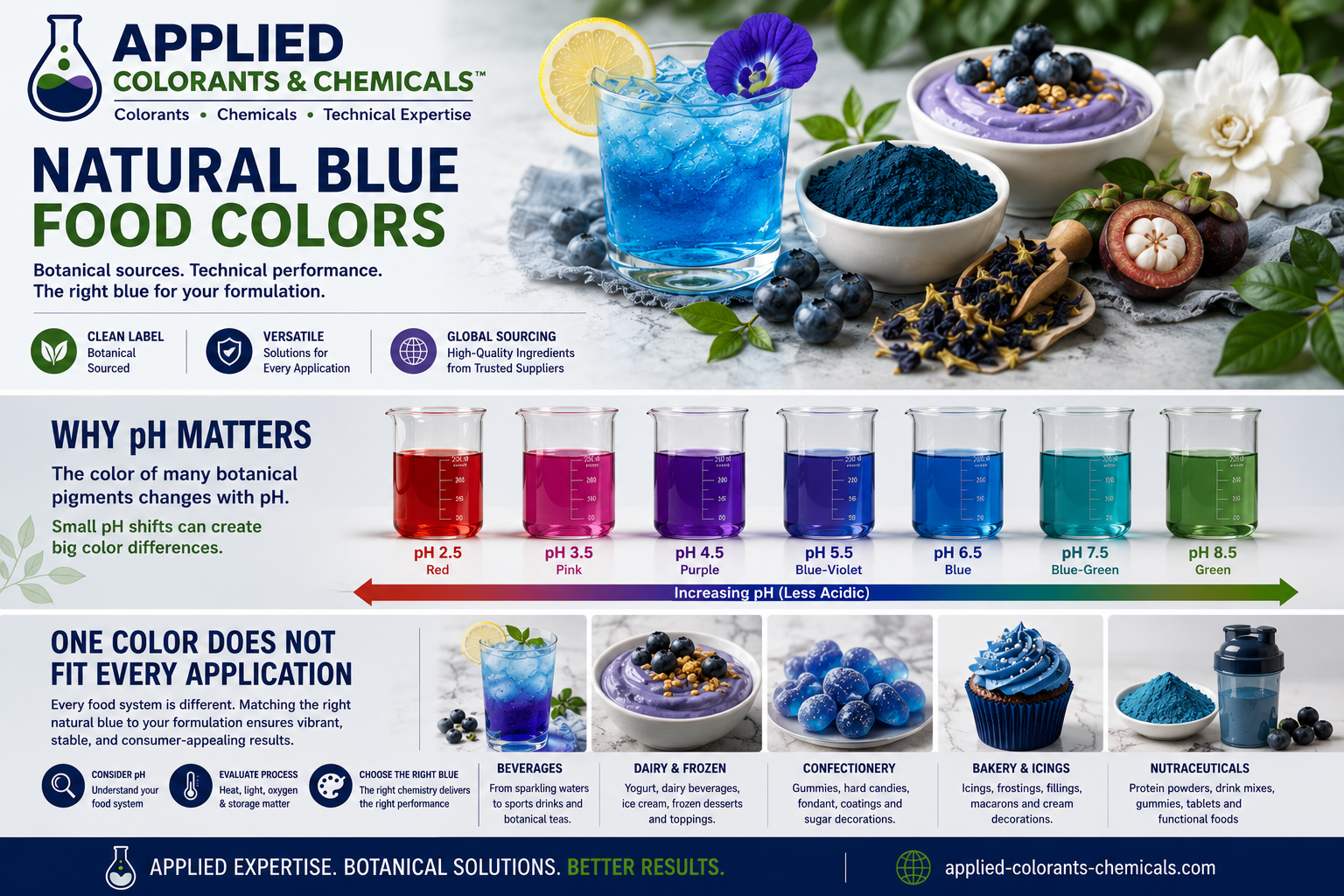
Perhaps no single factor influences natural blue food colors more than product pH.
Many natural pigments are sensitive to hydrogen ion concentration, causing noticeable color shifts as products become more acidic or more neutral.
For this reason, formulators should evaluate pH early in product development rather than selecting a color solely on its appearance in a supplier sample.
Highly Acidic Products (pH 2.5–3.5)
Examples include:
- Carbonated soft drinks
- Sports beverages
- Fruit juices
- Energy drinks
- Lemonades
These formulations often present the greatest challenge because many botanical pigments shift toward purple or red under acidic conditions.
Moderately Acidic Products (pH 3.5–5.0)
Examples include:
- Flavored waters
- Kombucha
- Yogurt drinks
- Smoothies
- Fruit sauces
Several natural blue systems may perform well in this range depending upon formulation, processing conditions, and desired color intensity.
Near Neutral Products (pH 6–7)
Examples include:
- Dairy beverages
- Ice cream
- Frostings
- Protein beverages
- Nutritional powders
These products often provide the most favorable environment for spirulina-based blue colors, allowing formulators to achieve bright sky-blue shades.
Selecting Natural Blue Food Colors by Application
Successful color selection depends on the entire formulation—not simply the desired shade.
Beverages
Beverages present unique formulation challenges because acidity, pasteurization, dissolved oxygen, and package transparency all influence color stability.
Manufacturers should evaluate:
- Product pH
- Heat treatment
- Shelf-life expectations
- Light exposure
- Carbonation
- Flavor interactions
Dairy Products
Yogurts, milk-based beverages, frozen desserts, and cultured products often provide favorable conditions for several natural blue color systems because their pH is generally less aggressive than fruit beverages.
Bakery Products
Baked goods introduce additional challenges due to elevated processing temperatures.
Color selection should consider:
- Baking temperature
- Moisture loss
- Finished water activity
- Product pH
- Fat content
Certain natural colors may be better suited for frostings, fillings, or decorations than for products exposed to extended baking.
Confectionery
Hard candies, gummies, chewy candies, fondants, and sugar decorations require careful evaluation of both processing temperature and long-term storage stability.
Desired color intensity, transparency, and processing conditions often determine which botanical color system is most appropriate.
Nutraceuticals and Dietary Supplements
Natural blue food colors continue gaining popularity in nutritional powders, protein beverages, gummies, chewable tablets, wellness shots, and functional foods.
Manufacturers frequently prioritize clean-label declarations and botanical sourcing when selecting colors for these products.
Commercial Forms of Natural Blue Food Colors
One of the advantages of today’s natural color market is the wide variety of commercial forms available. Manufacturers can select the format that best fits their production equipment, processing conditions, and finished product requirements.
Depending on the supplier, natural blue food colors may be available as:
- Liquid concentrates
- Water-soluble liquids
- Powdered extracts
- Spray-dried powders
- Oil-dispersible systems (for selected applications)
- Standardized color concentrates
- Custom color blends
- Applied Colorants & Chemicals has access to over 1100 natural color blends for food and beverage applications!
Choosing the proper format can simplify manufacturing, improve batch-to-batch consistency, reduce handling time, and enhance dispersion throughout the finished product.
For example, beverage manufacturers often prefer liquid concentrates for ease of incorporation into mixing systems, while dry beverage mixes and nutritional powders may benefit from spray-dried or powdered color systems that improve shelf life and simplify dry blending.
Processing and Storage Considerations
Selecting a natural blue food color involves more than choosing the desired shade. Manufacturing conditions can significantly influence color performance throughout the product’s shelf life.
Key factors to evaluate include:
Heat Processing
Pasteurization, hot-fill processing, retorting, baking, and other thermal treatments may affect color stability differently depending on the botanical source.
Whenever possible, color selection should reflect the actual manufacturing process rather than laboratory conditions alone.
Light Stability
Natural pigments vary in their resistance to ultraviolet and visible light exposure.
Products packaged in clear bottles, jars, or display cases may require additional evaluation to maintain color consistency throughout their intended shelf life.
Oxygen Exposure
Oxidation may gradually reduce color intensity in some botanical pigments.
Manufacturers often evaluate oxygen barrier packaging, headspace management, antioxidants, and processing methods to improve long-term stability.
Ingredient Interactions
Proteins, minerals, sugars, acids, preservatives, and other ingredients may influence the appearance of natural colors. Because every formulation is unique, pilot testing remains one of the most valuable tools during product development.
Ingredient sourcing can also play an important role in successful formulation. Variations in raw material quality, botanical source, extract standardization, carrier systems, and ingredient purity can all influence color performance and batch-to-batch consistency. Working with experienced ingredient sourcing partners can help manufacturers identify qualified suppliers, evaluate alternative natural color technologies, and secure reliable sources that meet technical, regulatory, and commercial requirements.
Regulatory Considerations
Regulations governing natural food colors vary by country and region. Ingredient approvals, permitted applications, labeling requirements, and usage limitations may differ between the United States, Canada, the European Union, Asia-Pacific markets, and other international jurisdictions.
Before commercializing a new product, manufacturers should confirm that the selected color is approved for the intended application and target market.
Working with knowledgeable suppliers helps ensure that color selection aligns with current regulatory requirements and customer expectations.
How to Choose the Right Natural Blue Food Color
Rather than asking, “Which natural blue is the best?”, formulators often achieve better results by asking a different question:
“Which natural blue performs best in my specific food system?”
A systematic evaluation can simplify the selection process.
Consider the following questions:
- What is the product’s pH?
- Will the product be refrigerated, frozen, or shelf stable?
- Will it undergo pasteurization, baking, or other heat processing?
- What shelf life is required?
- Will consumers expect a bright sky blue, navy blue, teal, violet, or berry-blue appearance?
- Is a clean-label declaration a priority?
- Will the product be packaged in clear containers?
- Does the formulation contain proteins, fruit acids, minerals, or fats that could influence color performance?
Answering these questions early can reduce reformulation, improve manufacturing efficiency, and help achieve a more consistent finished product.
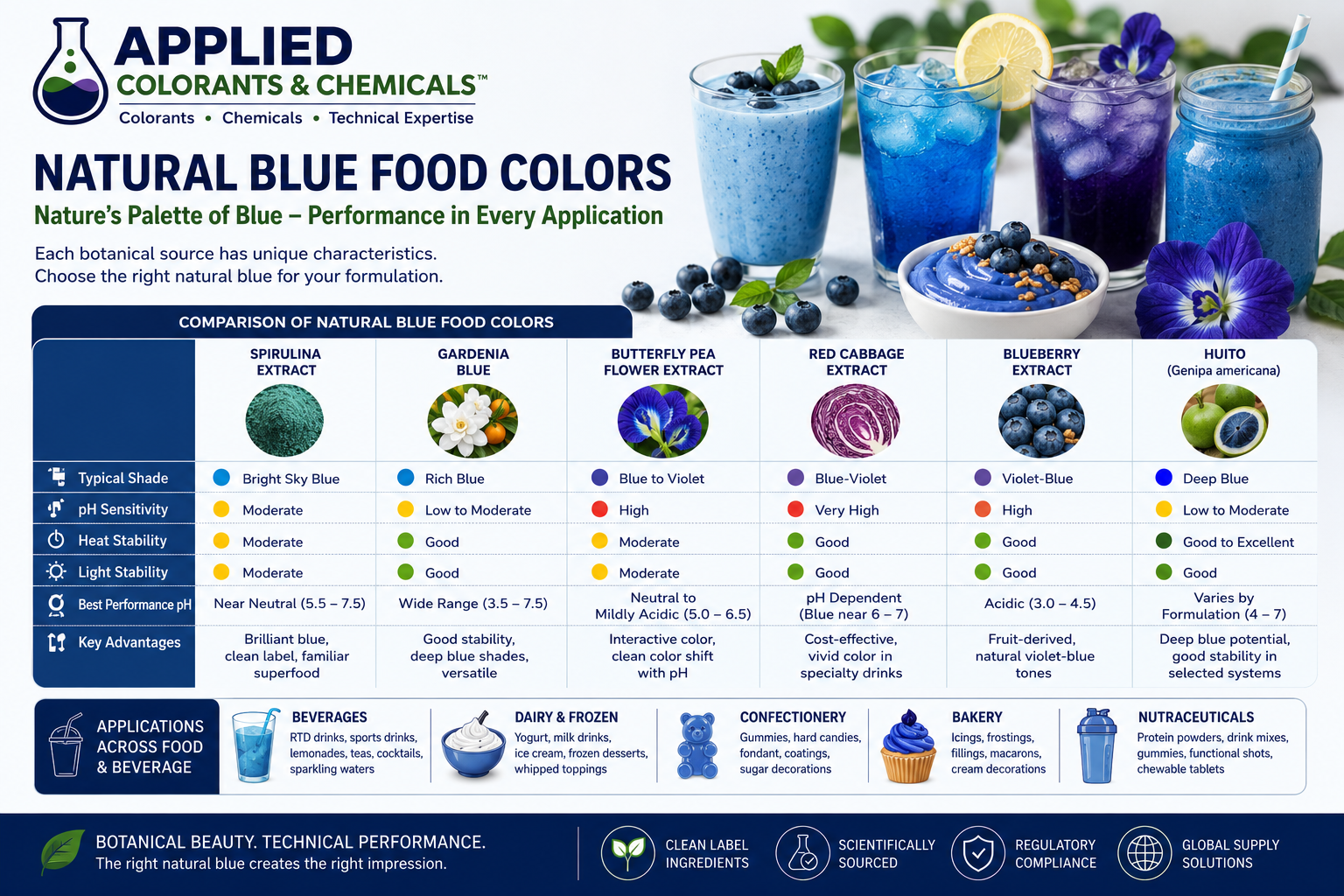
Comparison of Natural Blue Food Colors
| Color Source | Brightness | pH Sensitivity | Heat Stability | Typical Applications |
|---|---|---|---|---|
| Spirulina | Excellent | Moderate | Moderate | Dairy, smoothies, gummies, frostings |
| Gardenia Blue | Excellent | Low to Moderate | Good | Beverages, confectionery, processed foods |
| Butterfly Pea Flower | Excellent | High | Moderate | Botanical beverages, teas, novelty drinks |
| Red Cabbage Extract | Moderate | Very High | Good | Specialty beverages, candies |
| Blueberry | Moderate | High | Good | Fruit products, smoothies, yogurt |
| Huito – Jagua Blue | Deep Blue | Low to Moderate | Good to Excellent | Specialty foods and beverages |
Frequently Asked Questions
What is the brightest natural blue food color?
Spirulina extract is generally recognized for producing one of the brightest natural sky-blue shades under favorable formulation conditions. However, the best choice depends on the product’s pH, processing, and shelf-life requirements.
Why do some natural blue food colors turn purple?
Many botanical pigments, particularly anthocyanins found in butterfly pea flower, red cabbage, and blueberries, change color as acidity changes. This natural response explains why the same ingredient may appear blue in one product and violet in another.
Can natural blue food colors withstand pasteurization?
Heat stability varies by botanical source. Some natural blue pigments tolerate pasteurization well, while others may require modified processing conditions or formulation adjustments to maintain color intensity.
Are natural blue food colors available as liquids and powders?
Yes. Commercial suppliers offer natural blue food colors in a wide variety of formats, including liquid concentrates, water-soluble liquids, powders, spray-dried powders, emulsions, and customized color systems designed for specific manufacturing processes.
Which natural blue is best for beverages?
There is no single answer. Beverage formulation depends on pH, carbonation, processing temperature, packaging, and desired color. A blue color that performs well in a dairy beverage may not provide the same results in a highly acidic sports drink or carbonated soft drink.
Conclusion
Natural blue food colors have evolved from a niche specialty ingredient into an important category within modern food and beverage formulation. Advances in botanical extraction, purification, and color stabilization have expanded the range of options available to manufacturers seeking clean-label alternatives to synthetic colors – FD&C dyes.
Spirulina, gardenia blue, butterfly pea flower, red cabbage extract, blueberry-derived anthocyanins, Huito Jagua Blue, and other botanical sources each offer unique performance characteristics. Their success depends not on selecting the “best” pigment, but on matching the chemistry of the color to the chemistry of the finished food system.
By considering pH, processing conditions, packaging, storage, regulatory requirements, and the desired visual appearance early in product development, manufacturers can identify natural blue color systems that deliver both technical performance and consumer appeal.
As innovation continues, natural blue food colors will remain an exciting area of growth, helping food and beverage companies create vibrant, clean-label products that meet changing market expectations.
Performance characteristics of natural food colors may vary depending on formulation, processing conditions, pH, ingredient interactions, packaging, and storage. Product developers should conduct application-specific testing under actual manufacturing conditions before commercialization.
Why Work with Applied Colorants & Chemicals?
Selecting the right natural color often requires more than choosing a single ingredient. Manufacturers may need to evaluate multiple botanical sources, compare commercial formats, assess processing compatibility, or identify qualified global suppliers of natural colors and ingredients.
Applied Colorants & Chemicals works with food and beverage manufacturers to source natural color solutions and ingredients for a wide range of applications. Whether you’re developing beverages, confectionery, dairy products, nutritional supplements, bakery products, or specialty foods, we help connect manufacturers with reliable suppliers offering natural color technologies that align with their technical, regulatory, and commercial requirements.
If you’re exploring natural blue food colors or expanding your clean-label product portfolio, Contact Us to discuss your formulation goals and sourcing needs.
References
- U.S. Food and Drug Administration (FDA). Color Additives Permitted for Use in Food. Code of Federal Regulations, Title 21, Parts 73 and 74.
- U.S. Food and Drug Administration (FDA). Color Additives and Food Ingredients. https://www.fda.gov/food
- European Food Safety Authority (EFSA). Scientific Opinions on Food Colours and Food Additives. Parma, Italy.
- Codex Alimentarius Commission. General Standard for Food Additives (GSFA). FAO/WHO.
- International Association for Food Protection (IAFP). Resources on food ingredient safety and food processing.
- Sigurdson, G.T., Tang, P., & Giusti, M.M. (2017). Natural Colorants: Food Colorants from Natural Sources. Annual Review of Food Science and Technology, 8, 261–280.
- Martins, N., Roriz, C.L., Morales, P., Barros, L., & Ferreira, I.C.F.R. (2016). Food Colorants: Challenges, Opportunities and Current Desires of Agro-Industries to Ensure Consumer Expectations and Regulatory Practices. Trends in Food Science & Technology, 52, 1–15.
- Castañeda-Ovando, A., Pacheco-Hernández, M.L., Páez-Hernández, M.E., Rodríguez, J.A., & Galán-Vidal, C.A. (2009). Chemical Studies of Anthocyanins: A Review. Food Chemistry, 113(4), 859–871.
- Giusti, M.M., & Wrolstad, R.E. Anthocyanins: Characterization and Measurement with UV-Visible Spectroscopy. In: Current Protocols in Food Analytical Chemistry. John Wiley & Sons.
- Delgado-Vargas, F., Jiménez, A.R., & Paredes-López, O. (2000). Natural Pigments: Carotenoids, Anthocyanins and Betalains—Characteristics, Biosynthesis, Processing and Stability. Critical Reviews in Food Science and Nutrition, 40(3), 173–289.
- Francis, F.J. (1989). Food Colorants: Anthocyanins. Critical Reviews in Food Science and Nutrition, 28(4), 273–314.
- Wrolstad, R.E., Durst, R.W., & Lee, J. (2005). Tracking Color and Pigment Changes in Anthocyanin Products. Trends in Food Science & Technology, 16, 423–428.
- Clydesdale, F.M. (1993). Color as a Factor in Food Choice. Critical Reviews in Food Science and Nutrition, 33(1), 83–101.
- Society of Food Scientists and Technologists (Institute of Food Technologists – IFT). Technical resources on food ingredients, formulation, and color systems.
About the Author

Click to Enlarge