
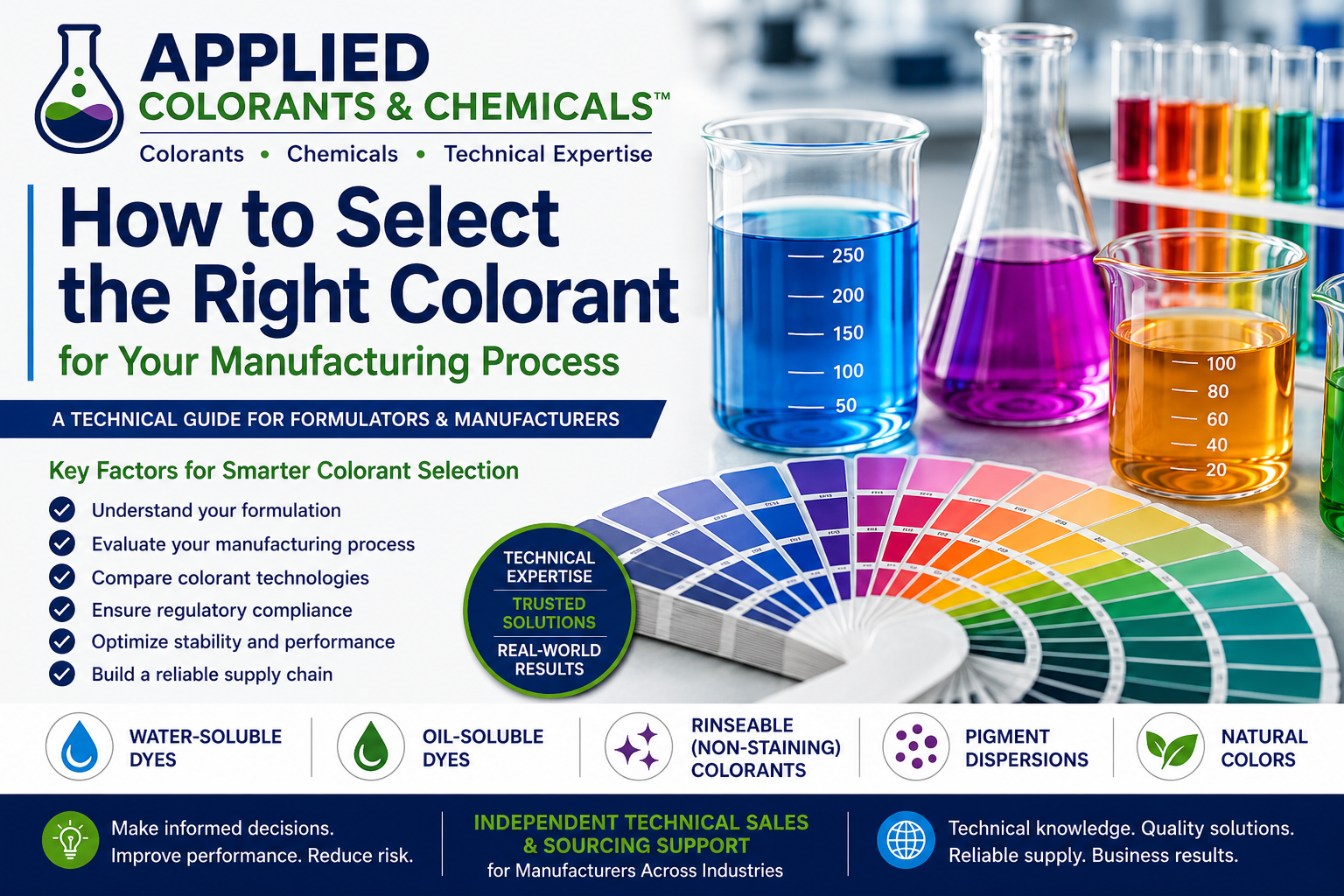
How to Select the Right Colorant for Your Manufacturing Process
A Technical Guide for Product Developers, Formulators, and Purchasing Professionals
Selecting the right colorant is about much more than achieving the desired shade. The color system chosen for a product can influence manufacturing efficiency, product stability, regulatory compliance, customer satisfaction, and long-term supply reliability.
Whether you’re developing a new formulation, improving an existing product, or qualifying an alternative supplier, selecting the appropriate colorant requires balancing chemistry, processing conditions, regulatory requirements, and performance expectations. A colorant that performs exceptionally well in one application may not perform the same way in another due to differences in pH, solvent systems, temperature, light exposure, packaging, or interactions with other formulation ingredients.
Manufacturers today have access to a wide range of color technologies, including water-soluble dyes, oil-soluble dyes, pigment dispersions, natural colors and natural lakes, and specialized technologies such as rinseable (non-staining) dyes or colorants. Each offers distinct advantages depending on the formulation, manufacturing process, and end-use application.
Applied Colorants & Chemicals helps manufacturers identify colorant and specialty chemical solutions for applications across food and beverage, personal care, household and industrial cleaners, water tracing and water treatment, agriculture such as fertilizer, pond, and turf, automotive care, adhesives and sealants, polyurethane systems, antifreeze, coolants and heat transfer fluids, and many other industrial markets.
Applied Colorants and Chemicals represents a network of qualified suppliers to help manufacturers identify the most appropriate solution for their technical, regulatory, and commercial requirements.
Why Color Selection Matters
Color is often one of the first characteristics customers notice about a product. It influences first impressions, reinforces brand identity, communicates product performance, and helps create a consistent customer experience. In many industries, product color also serves a functional purpose by identifying product type, concentration, fragrance, flavor, viscosity, or application.
A consistent color builds customer confidence. Conversely, color variations, fading, or instability may lead customers to question product quality, even when the formulation continues to perform as intended.
Selecting the proper colorant during product development can also reduce manufacturing challenges by improving formulation compatibility and minimizing unexpected performance issues after commercialization.
An effective color system should provide:
- Consistent batch-to-batch color
- Excellent compatibility with the formulation
- Stability during manufacturing and throughout the intended shelf life
- Compliance with applicable regulatory requirements
- Reliable long-term supply availability
- Cost-effective performance
- Ease of incorporation into existing manufacturing processes
Choosing an inappropriate colorant can result in reformulation costs, production delays, inconsistent product appearance, customer complaints, supply disruptions, and unnecessary quality investigations.
Click to Enlarge
Step 1: Understand Your Formulation
Before evaluating specific colorants, it is essential to understand the chemistry of the finished formulation. Every formulation presents unique challenges that influence color performance.
Important formulation characteristics include:
- Is the formulation primarily water-based or oil-based?
- What is the expected pH?
- Does the product contain surfactants, solvents, salts, oxidizers, or reducing agents?
- Will the product be diluted before use?
- What level of transparency or opacity is desired?
- Is the product intended for consumer or industrial use?
- What regulatory requirements apply to the finished product?
Answering these questions early helps narrow the available color technologies and reduces development time.
Water-Based Formulations
Water-soluble dyes are commonly selected for aqueous systems because they dissolve completely and produce bright, transparent colors without contributing visible particles.
Typical applications include:
- Food and beverages
- Household and industrial cleaners
- Water treatment chemicals
- Agricultural products
- Personal care products
- Detergents
- Pool and spa chemicals
Oil-Based Formulations
Oil-soluble dyes are specifically designed for non-aqueous systems where water-soluble dyes cannot dissolve effectively.
Common applications include:
- Lubricants
- Heat transfer fluids
- Fuels
- Petroleum products
- Candles
- Solvent-based coatings
- Certain polyurethane systems
Selecting the proper chemistry at the beginning of a project often eliminates unnecessary reformulation later.
Step 2: Evaluate Your Manufacturing Process
Even an excellent colorant can perform poorly if it is not compatible with the manufacturing process.
Processing conditions frequently determine whether a color system remains stable throughout production and storage.
Questions to consider include:
- What temperatures will the product experience during manufacturing?
- Will the finished product be exposed to ultraviolet (UV) light?
- Does the formulation contain oxidizing or reducing ingredients?
- Will the product be stored indoors or outdoors?
- Is the formulation acidic, neutral, or alkaline?
- Will the product be packaged in clear, translucent, or opaque containers?
- What shelf life is expected?
- Will customers dilute the product before use?
These factors can significantly influence color stability, fading, precipitation, or unexpected shade changes over time.
Considering manufacturing conditions early in product development helps prevent performance issues after commercialization and reduces the risk of costly product recalls or reformulation projects.
Step 3: Understand the Different Types of Colorants
Although the term colorant is often used broadly, several different color technologies are available. Each has unique performance characteristics and is designed for specific applications.
Selecting the most appropriate technology depends on the formulation chemistry, desired appearance, manufacturing process, regulatory requirements, and end-use performance expectations.
Water-Soluble Dyes
Water-soluble dyes are among the most widely used colorants for aqueous formulations. Because they dissolve completely in water, they produce bright, transparent colors without leaving visible particles or sediment. This makes them an excellent choice for products where clarity and uniform color are important.
Typical applications include:
- Food and beverages
- Household and industrial cleaners
- Laundry detergents
- Water treatment chemicals
- Agricultural products
- Personal care products
- Pool and spa chemicals
- Water-based specialty chemicals
Water-soluble dyes are available in both liquid and powder forms. The most appropriate format depends on manufacturing requirements, storage considerations, shipping costs, and production efficiency.
Manufacturers should also evaluate factors such as pH stability, light stability, temperature resistance, compatibility with formulation ingredients, and regulatory requirements before selecting a specific dye.
Oil-Soluble Dyes
Oil-soluble dyes are designed for formulations where water-soluble dyes cannot dissolve effectively. They provide clear, transparent color in non-aqueous systems while maintaining excellent compatibility with oils, fuels, solvents, waxes, and petroleum-based products.
Common applications include:
- Lubricants
- Hydraulic fluids
- Heat transfer fluids
- Fuels
- Petroleum products
- Candles
- Solvent-based coatings
- Certain polyurethane systems
- Industrial maintenance products
Because oil-based formulations vary considerably, manufacturers should evaluate solvent compatibility, operating temperatures, UV exposure, and long-term storage conditions when selecting an oil-soluble dye.
Rinseable (Non-Staining) Dyes or Colorants
In many applications, selecting the appropriate colorant involves more than simply achieving the desired shade. Manufacturers must also consider what happens after the product is used.
Products such as vehicle wash detergents, household and industrial cleaners, toilet bowl cleaners, agricultural spray indicators, and other specialty formulations often benefit from colorants designed to rinse away cleanly without leaving visible stains on surfaces, equipment, fabrics, or skin.
Rinseable (non-staining) dyes or colorants provide effective product identification while minimizing the potential for residual staining during normal use. Selecting the appropriate technology depends on several factors, including formulation chemistry, dilution rate, substrate, application method, and customer performance expectations.
Evaluating rinseable dyes or colorant technologies early in the development process can improve product performance, reduce customer complaints, and help differentiate products in competitive markets.
Pigment Dispersions
Unlike dyes, pigments do not dissolve into a formulation. Instead, finely dispersed pigment particles remain suspended within the product, producing opaque color and excellent hiding power.
Pigment dispersions are often selected when applications require:
- Opacity
- High color strength
- Surface coverage
- Lightfastness
- Weather resistance
- Exterior durability
- UV resistance
Typical applications include coatings, plastics, construction products, agricultural products, adhesives, sealants, and numerous industrial formulations.
Proper dispersion quality is essential to achieving consistent color development and preventing settling, agglomeration, or manufacturing issues.
Natural Colors and Natural Lakes
Consumer demand for naturally derived ingredients continues to increase across many industries, particularly food and beverage, personal care, and certain household products.
Natural colors can be sourced from fruits, vegetables, algae, minerals, and other naturally occurring materials. They allow manufacturers to align with clean-label initiatives while meeting consumer preferences for products formulated with naturally derived ingredients.
Although natural colors offer many advantages, they may require additional formulation considerations because they can be more sensitive to factors such as:
- pH
- Temperature
- Light exposure
- Oxidation
- Processing conditions
- Shelf-life requirements
Selecting the appropriate natural color often requires balancing appearance, stability, regulatory compliance, and manufacturing requirements.
Regulatory Considerations
Regulatory compliance should be evaluated early during product development rather than after a formulation has been completed.
Depending on the intended application and geographic market, manufacturers may need to consider:
- Product-specific regulations
- Approved color additive lists
- Labeling requirements
- Purity specifications
- Customer requirements
- International regulatory differences
Selecting a colorant that satisfies both technical and regulatory requirements can reduce development time and help avoid costly reformulation later.
Color Stability
A colorant’s appearance immediately after manufacturing does not necessarily predict how it will perform throughout the product’s shelf life.
Color stability may be affected by:
- Heat
- Ultraviolet (UV) light
- Oxygen
- pH
- Oxidizing ingredients
- Reducing ingredients
- Metal ions
- Packaging materials
- Storage conditions
Conducting stability testing under realistic manufacturing and storage conditions can help identify potential issues before commercial production begins.
Evaluating stability early often saves significant time, reduces customer complaints, and minimizes unnecessary reformulation costs.
Selecting the right colorant involves balancing appearance, performance, manufacturability, regulatory compliance, and long-term reliability. Taking a comprehensive approach during product development helps manufacturers improve product quality while reducing technical and commercial risk.
Step 4: Common Mistakes When Selecting Colorants
Selecting a colorant based solely on achieving the desired shade can lead to unexpected formulation challenges, manufacturing issues, and increased development costs. While color is often one of the final formulation decisions, it should be evaluated alongside the product’s chemistry, processing conditions, regulatory requirements, and long-term performance expectations.
Below are some of the most common mistakes manufacturers encounter during color selection.
Selecting a Colorant Based on Color Alone
Two colorants may appear nearly identical in the laboratory yet perform very differently in commercial production.
A colorant should always be evaluated based on its compatibility with the complete formulation, not simply the shade it produces. Factors such as pH, solvent system, temperature, UV exposure, oxidation, ingredient interactions, and storage conditions all influence long-term performance.
Waiting Until Late in Product Development
Color selection is sometimes postponed until the formulation is nearly complete. Unfortunately, this can result in additional testing or reformulation if the selected colorant proves incompatible with the finished product. Evaluating color technologies early in the development process often shortens project timelines and reduces overall development costs.
Overlooking Manufacturing Conditions
Manufacturing conditions can have a significant impact on color performance.
Considerations include:
- High processing temperatures
- Mixing equipment
- Order of ingredient addition
- Shear forces
- Processing time
- Storage temperatures
- Packaging materials
A colorant that performs well under laboratory conditions may respond differently in full-scale production if these factors are not considered.
Ignoring Long-Term Stability
A product that looks perfect immediately after manufacturing may not maintain the same appearance months later. Manufacturers should evaluate color stability under conditions that closely reflect actual storage and use. Accelerated stability testing can help identify potential changes caused by heat, light, oxidation, humidity, or prolonged storage.
Choosing Price Instead of Overall Value
The lowest-cost colorant is not always the most economical choice. Performance differences may influence usage levels, manufacturing efficiency, product consistency, customer satisfaction, and shelf life. Selecting a higher-performing colorant can often reduce overall production costs by minimizing waste, improving consistency, and avoiding reformulation.
Failing to Plan for Supply Chain Disruptions
Many manufacturers learned during recent global supply chain disruptions that relying on a single source can create unnecessary business risk. Developing relationships with qualified suppliers and evaluating alternative sourcing strategies can improve supply continuity and reduce production interruptions.
Step 5: Building a Reliable Color Supply Chain
Selecting the right colorant extends beyond technical performance. Manufacturers should also evaluate the long-term reliability of their supply chain.
Important considerations include:
- Supplier technical expertise
- Manufacturing capabilities
- Product quality systems
- Regulatory documentation
- Manufacturing capacity
- Geographic diversification
- Inventory availability
- Lead times
- Business continuity planning
Many companies now include supply chain resilience as part of their formulation strategy rather than treating it as a purchasing issue alone.
The Value of Qualified Second Sources
Depending on the application, qualifying an alternative supplier before it becomes necessary can help reduce operational risk.
Benefits may include:
- Reduced supply interruptions
- Greater purchasing flexibility
- Improved negotiating position
- Enhanced business continuity
- Faster response to unexpected shortages
- Increased confidence during periods of market volatility
Although qualifying an alternative source requires planning and testing, many manufacturers find the investment worthwhile for critical raw materials.
Step 6: When to Work with a Technical Color Specialist
Many color selection challenges can be avoided by involving technical expertise early in the formulation process.
A technical color specialist can assist with:
- Selecting the appropriate color technology
- Evaluating formulation compatibility
- Reviewing regulatory considerations
- Improving color stability
- Identifying potential manufacturing concerns
- Recommending alternative color systems
- Supporting reformulation projects
- Identifying qualified supply options
Early collaboration often reduces development time while helping manufacturers avoid costly reformulation and production delays.
Conclusion
Selecting the right colorant involves balancing appearance, chemistry, manufacturing requirements, regulatory compliance, product performance, costs, and supply reliability.
Whether a formulation requires water-soluble dyes, oil-soluble dyes, pigment dispersions, natural colors, or specialized rinseable (non-staining) dyes or colorants, taking a comprehensive approach during product development can improve manufacturing efficiency, reduce technical risk, and enhance product consistency throughout the product lifecycle.
Applied Colorants & Chemicals provides independent technical expertise and sourcing to help manufacturers identify colorant and specialty chemical solutions that align with their formulation, manufacturing, and commercial objectives. By representing a network of qualified suppliers, customers receive available technologies and practical solutions tailored to their specific applications.
Whether you are developing a new product, replacing an existing colorant, qualifying a second source, or troubleshooting a formulation challenge, we welcome the opportunity to discuss your project and help identify the right solution.
Frequently Asked Questions
1. How do I choose the right colorant for my product?
Selecting the right colorant begins with understanding your formulation chemistry, manufacturing process, regulatory requirements, desired appearance, and performance expectations. Factors such as pH, temperature, solvent system, light exposure, and shelf-life requirements should all be evaluated before making a final selection.
2. What is the difference between a dye and a pigment?
Dyes dissolve completely in a formulation and generally produce clear, transparent color. Pigments remain as finely dispersed solid particles that provide opacity, hiding power, and enhanced durability. The appropriate choice depends on the product’s appearance and performance requirements.
3. When should I use a water-soluble dye?
Water-soluble dyes are best suited for aqueous formulations such as beverages, household and industrial cleaners, detergents, water treatment chemicals, agricultural products, and many personal care applications where bright, transparent color is desired.
4. When are oil-soluble dyes recommended?
Oil-soluble dyes or solvent-soluble dyes are designed for non-aqueous formulations including lubricants, fuels, heat transfer fluids, petroleum products, solvent-based coatings, candles, and other oil-based systems where water-soluble dyes cannot dissolve.
5. What are rinseable (non-staining) dyes or colorants?
Rinseable (non-staining) dyes or colorants are designed to provide product identification while minimizing residual staining after normal use. They are commonly used in applications such as vehicle wash products, household and industrial cleaners, toilet bowl cleaners, agricultural spray indicators, and other specialty formulations where staining is undesirable.
6. Are natural colors suitable for industrial applications?
Natural colors are widely used in food, beverage, and personal care products and may also be suitable for certain specialty applications. Because they can be more sensitive to pH, heat, oxidation, and light exposure, manufacturers should evaluate their stability under actual processing and storage conditions.
7. Why does color sometimes change during storage?
Color changes can result from exposure to heat, ultraviolet light, oxidation, pH changes, ingredient interactions, packaging materials, or extended storage conditions. Stability testing helps identify potential issues before commercial production.
8. Can the same colorant be used in every formulation?
No. Even if two products appear similar, differences in chemistry, solvents, processing conditions, or ingredients may require different color technologies or formulations.
9. Why is pH important when selecting a colorant?
Many colorants perform differently depending on the pH of the formulation. Some maintain excellent stability across a broad pH range, while others may shift color, fade, or lose intensity under acidic or alkaline conditions.
10. How important is UV stability?
For products exposed to sunlight or other ultraviolet light sources, UV stability can significantly influence long-term color performance. Selecting a colorant with appropriate light stability helps maintain product appearance throughout its intended shelf life.
11. Should I qualify a second source for my colorants?
Many manufacturers choose to qualify alternative suppliers for critical raw materials to improve supply chain resilience, reduce business risk, and minimize the impact of unexpected supply disruptions.
12. Can colorants affect manufacturing efficiency?
Yes. Colorants that disperse easily, remain stable during processing, and are compatible with the formulation can improve manufacturing efficiency while reducing waste, production delays, and quality concerns.
13. How early should color selection be considered during product development?
Color selection should ideally be evaluated early in formulation development. Considering color technology alongside formulation chemistry often reduces development time and minimizes the need for costly reformulation later in the project.
14. What information should I provide when requesting technical assistance?
Helpful information includes the product application, formulation type, desired color, processing conditions, pH, operating temperatures, regulatory requirements, packaging, and any performance challenges or existing colorant limitations.
15. How can Applied Colorants & Chemicals help?
Applied Colorants & Chemicals provides independent technical sales, colorant expertise, and specialty chemical sourcing support for manufacturers across a wide range of industries. For your next project, please feel free to reach out.
About the Author

Click to Enlarge